From “No Software” to multi-cloud CRM, Salesforce has never been shy about big platform shifts. With each evolution, it has reshaped how organisations think about customer relationships. But the changes emerging across Marketing Cloud and Commerce Cloud right now feel a lot more foundational.
Salesforce is quietly redefining how work happens across the platform, and not simply just adding AI features.
One of the more telling signals of this shift is that Salesforce leadership has started to talk more about outcomes, agents, and intelligence. This reflects a broader move away from standalone products and toward a unified, AI-first platform where data, automation, and decision-making are deeply connected.
For Marketing Cloud and Commerce Cloud users, this matters. These tools are no longer just execution layers for campaigns or transactions - they’re becoming adaptive systems that respond to customer behaviour in real time.
Marketing Cloud’s evolution is pushing teams beyond scheduled campaigns and static journeys. With deeper integration into Data Cloud and AI-driven orchestration, marketing is shifting toward always-on engagement.
What’s changing in practice:
The big shift is it's autonomy. Marketing Cloud is moving toward a model where systems can decide when and how to engage, not just what message to send.
Commerce Cloud is following a similar trajectory. The platform is evolving from a transactional engine into an intelligent commerce layer that supports B2C, B2B, and DTC experiences from a single foundation.
Key themes emerging:
The result is commerce that adapts continuously to the customer, but also to what they’re doing right now.
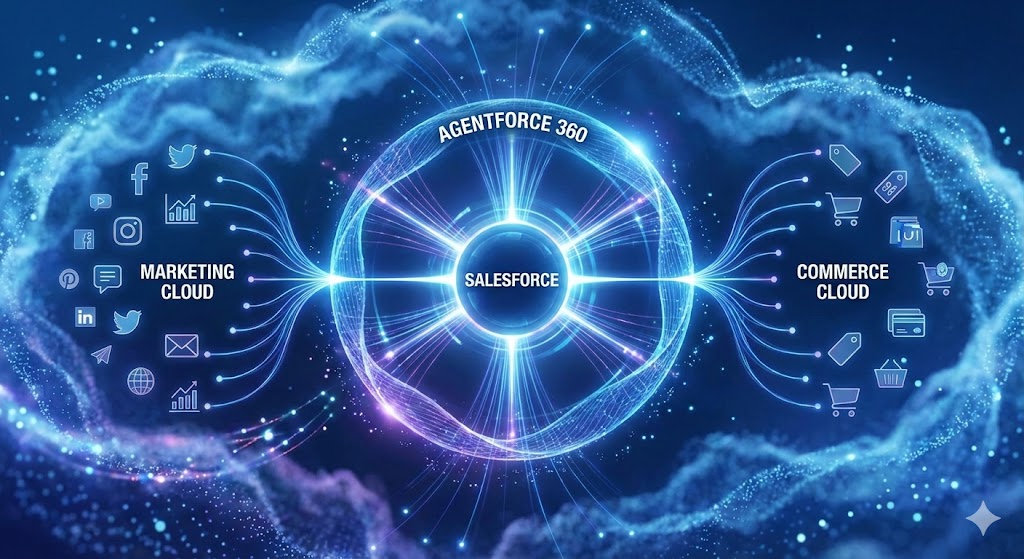
Agentforce 360 provides the connective layer that allows AI agents to operate across Marketing Cloud, Commerce Cloud, Sales, and Service, using Data Cloud as a shared source of truth. Instead of isolated intelligence, organisations can deploy agents that understand context and take action across the entire customer lifecycle.
Why this matters:
For marketing teams, this shifts the mindset from building campaigns to orchestrating outcomes. For commerce teams, it enables always-on, personalised buying experiences that evolve as customer behaviour changes.
Many organisations are still thinking about AI as an add-on. Salesforce’s direction suggests something more ambitious: AI as an operating model.
This has real implications:
The companies that benefit most won’t be the ones who adopt the most features, but the ones who redesign how marketing and commerce actually function.
Salesforce’s latest moves are about freeing teams from operational drag so they can focus on creativity, strategy, and customer value.
We’re moving from systems that support work to systems that participate in it. And for anyone building on Salesforce today, that’s a shift worth paying attention to.